The Lujiazui Forum 2026: What Beijing Just Told Foreign Investors About China's Capital Markets
The 2026 Lujiazui Forum marked a structural inflection point: direct finance has surpassed bank loans. With new QFII CGB futures and PBoC Repo facilities, Beijing is making RMB a fully hedgeable, investable global reserve asset.
The Setup
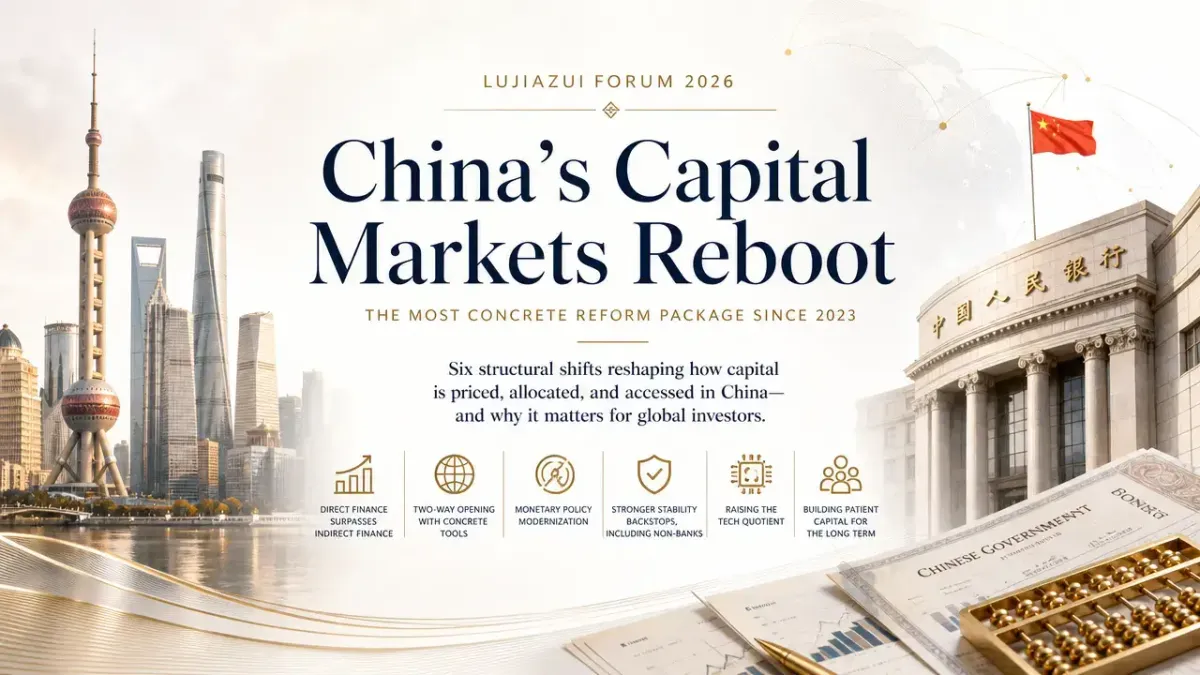
On June 17, 2026, the Lujiazui Forum opened in Shanghai under the theme "Financial Development and Cooperation Under the Global Governance Initiative." In a single morning, four of China's most senior financial regulators — PBoC Governor Pan Gongsheng, CSRC Chairman Wu Qing, NFRA Director Ding Xiangqun, and SAFE Director Zhu Hexin — laid out what is, in aggregate, the most concrete capital markets reform package China has issued since the 2023 SASAC reform.
Vice Premier He Lifeng opened the forum. The signal from the top: this is not an aspirational document. These are policies with implementation timelines.
For foreign investors, the headline is simple: Beijing just told you what's actually changing in how capital is priced, allocated, and accessed in China — and a meaningful share of it is directly relevant to whether RMB assets become more investable for non-Chinese capital.
1. The Structural Shift: Direct Finance Has Crossed Indirect Finance for the First Time
Pan Gongsheng disclosed a number that deserves to lead this analysis:
In 2025, bond and equity financing combined accounted for 47% of total social financing flow, surpassing bank loans (45%) for the first time. By year-end, indirect finance had fallen to roughly two-thirds of stock; direct finance has risen to one-third.
For a financial system that has been bank-loan-dominated for forty years, this is a structural inflection point, not an annual fluctuation. Pan explicitly framed it as "a long-term, trend-level change" reflecting the broader shift from old-economy capital intensity to new-economy R&D and equity-funded growth.
Why this matters for foreign investors: in a bank-dominated system, foreign capital is structurally marginalized — bank credit allocation is a domestic policy lever. In a direct-finance system, foreign capital can participate at parity with domestic capital through the bond and equity markets. The accessible share of China's financial system is mechanically growing, regardless of any single policy.
2. The Two-Way Opening: Specific Tools, Not Slogans
This is where the forum delivered the most concrete instruments.
Inbound: The Foreign Central Bank Repo Facility
Pan announced the creation of a Foreign Central Bank Repo Facility, which allows foreign central banks, monetary authorities, international financial organizations, and sovereign wealth funds to obtain RMB liquidity from the PBoC by pledging Chinese government bonds and other high-grade bonds as collateral.
Translated for a North American allocator: Chinese government bonds just became "near-hard-currency" collateral in the eyes of any foreign sovereign holder. The mechanism is structurally similar to the Fed's Primary Dealer Credit Facility — except it's accessible to foreign official institutions for RMB liquidity. This is the single most consequential step toward RMB reserve currency status that has been taken in years.
The downstream effect: foreign sovereign holders no longer face the historical problem of "easy to hold, hard to fund" with Chinese government bonds. The opportunity cost and liquidity premium of holding RMB assets just dropped.
Inbound: QFII Access to Domestic Treasury Futures + Hong Kong RMB Bond Futures
Wu Qing announced that QFII will be allowed to participate in onshore CGB (Chinese Government Bond) futures, and that 5-year RMB-denominated CGB futures will launch on the Hong Kong Exchange shortly.
For foreign fixed-income desks, this closes the most-cited gap in trading Chinese rates: until now, foreign investors holding Chinese government bonds had no clean way to hedge duration risk. With CGB futures access, RMB rates becomes a tradable, hedgeable asset class — not a one-way carry trade.
Inbound: Active ETFs + Commercial Real Estate REITs
Wu also announced Active ETFs on the Shanghai and Shenzhen exchanges, and a pilot for Commercial Real Estate REITs (with the first four projects to list on SSE).
For income-oriented foreign capital, commercial real estate REITs are the cleanest cash-flow vehicle in China that has ever existed. This is also the first formal acknowledgment that China's commercial real estate stock — long trapped on developer balance sheets — needs a securitization exit.
Outbound: New QDII Quotas
Zhu Hexin confirmed a new round of QDII quota issuance on top of optimizations to ODI, foreign debt, and cross-border equity incentive rules. As of end-May 2026, total QDII quota stands at $176.169 billion. The last meaningful expansion was in 2020-2021.
Implication: Chinese institutional money is being systematically allowed back into global markets at a moment when capital outflow pressure is supposed to be the policy concern. This is a confidence signal.
Offshore: Shanghai FTZ Offshore RMB FX Trading Pilot
Six banks (ICBC, ABC, BOC, CCB, BoCom, CITIC) are authorized to conduct offshore RMB FX trading via Shanghai FTZ. Combined with the foreign central bank repo facility, this builds — for the first time — a complete offshore RMB infrastructure stack: liquidity supply (PBoC repo) + trading venue (Shanghai FTZ) + hedging instruments (HK CGB futures + onshore FX futures pilot).
If you've been waiting for the institutional plumbing that would make RMB a real reserve asset, this is what it looks like.
3. The Monetary Policy Modernization: From Quantity to Price
Pan announced the most technical but possibly most important change for cross-asset investors: a narrowing and rebalancing of China's interest rate corridor.
The previous "soft corridor" introduced in July 2024 was asymmetric: 7-day reverse repo rate −20bp / +50bp (70bp width). Pan announced the new corridor as ±25bp around the 7-day reverse repo (50bp width, symmetric).
He also announced that the PBoC will add overnight reverse repo operations to its toolbox, aligning China's framework with the Fed's EFFR and the BOJ's overnight rate as the primary policy anchor.
Why a foreign investor should care: until now, the absence of a clean short-rate anchor in China made offshore RMB rates derivatives expensive and CNH/CNY arbitrage messy. A narrower, symmetric corridor with overnight operations means Chinese short rates become more predictable, and RMB rates derivatives become cheaper to price. This directly improves the unit economics of any RMB-denominated carry, hedging, or relative-value trade.
CICC's read, embedded in their commentary: with a narrower corridor, China is converging toward the lower end of the typical 50-200bp range used by major central banks. Pan also signaled that CGB yield curves should become a benchmark for loan pricing — meaning Chinese rates markets are moving toward the US/EU/Japan model where the sovereign curve is the operational reference.
4. Capital Markets Stability: Hard Backstops, Now Including Non-Banks
Two stability mechanisms were confirmed or expanded:
Existing tools maintained: Pan reaffirmed that Central Huijin will continue to function as a "quasi-stabilization fund" for equity markets. The Securities, Funds & Insurance Companies Swap Facility (SFISF) and the stock buyback re-lending facility — both created in September 2024 — remain in place as the central bank's formal channel to provide liquidity to capital markets.
New tool: Pan announced research on a "Specific-Scenario Non-Bank Liquidity Support Macroprudential Tool." When bond or other markets face systemic stress, normal liquidity channels are blocked, and non-bank institutions face collective liquidity crises that may trigger systemic risk, the PBoC will provide emergency liquidity to non-bank institutions via swap mechanisms.
In plain English: China is building a "lender of last resort" function for asset managers, brokers, insurers, and funds — not just banks. This is exactly the gap that triggered the 2023 LDI crisis in UK gilts and the 2020 Treasury market dislocation in the US. China is institutionalizing the answer before the event.
For foreign investors, this means the tail risk of a 2015-style equity panic or a non-bank fund-driven bond market dislocation is now formally backstopped. It does not eliminate the risk; it caps the cost.
5. The Capital Markets "Tech Quotient" Will Rise — and the Plumbing Behind It
Wu Qing announced two specific changes to the STAR Market (Shanghai's tech board):
- Standard Five (the listing standard for unprofitable hard-tech companies) will be expanded to include AI companies — explicitly to support "high-quality AI large-model enterprises" listing on STAR.
- Quantum technology, biomanufacturing, and embodied intelligence (humanoid robotics) companies will be eligible to list on STAR.
This is the equity-market-side counterpart to the "New Quality Productive Forces" policy framework that has become Beijing's master industrial policy concept. Read together with:
- Patient capital cultivation (insurance and pension long-cycle stock investment pilots)
- Long-cycle assessment mechanisms for institutional investors
- The shelf registration mechanism for refinancing
- Support for qualified Hong Kong-listed firms to dual-list onshore
…the picture is a deliberate plumbing upgrade designed to route domestic long-duration capital into hard-tech equity at scale, while making the access surface broader for foreign capital that wants the same exposure.
Wu also disclosed the current shape of the listed China tech complex: STAR + ChiNext now host over 2,000 companies with combined market cap exceeding ¥35 trillion, with cluster effects in new energy, semiconductors, biopharma, and high-end equipment manufacturing.
6. The Patient Capital Build-Out: The Single Most Important Long-Term Signal
Wu Qing disclosed a number that should reframe how foreign allocators think about Chinese equity flows:
Over the past two years, social security, insurance, and pension assets have grown their A-share float holdings by 85% and net-bought roughly ¥1.3 trillion of A-shares.
The institutional reform behind this: long-cycle performance assessment frameworks for insurance funds, insurance long-term equity investment pilots, and mutual fund reform. Translated: the historical mismatch in Chinese institutional investing — long-duration liabilities being measured by short-duration KPIs — is being structurally fixed.
For foreign investors, this matters in two ways:
First, the marginal buyer of Chinese equity is now domestic patient capital, not retail. This changes the volatility profile, the pricing efficiency, and the dividend response of A-shares over the next 3-5 years.
Second, when ¥1.3 trillion of net buying from sticky money over 24 months has not yet meaningfully closed the SOE valuation discount, the implication is that the discount is sustained by foreign-investor governance perception, not by lack of domestic demand. This is consistent with the analysis I've published in the SOE Discount series at ashareinsights.com — and the Lujiazui Forum just confirmed it from the policy side.
What This Does Not Solve
Three honest caveats.
1. None of this addresses the geopolitical overhang. ADR delisting risk, VIE structure uncertainty, and Section 13(f) disclosure complexity for US-domiciled funds holding Chinese securities are unchanged by anything announced at Lujiazui. These are Washington problems, not Beijing problems.
2. Implementation lag is real. Chinese financial reform has historically run on a 12-24 month gap between announcement and operational effect. The Foreign Central Bank Repo Facility, in particular, will need a counterparty list, operational procedures, and at least one cycle of usage before foreign sovereign holders treat it as reliable.
3. The "patient capital" build-out is a multi-year project. ¥1.3 trillion of net buying over 24 months is meaningful but not transformative. It will take a sustained 5+ year period of long-cycle assessment frameworks to fundamentally change the volatility and valuation profile of A-shares.
The Read for North American Investors
Three takeaways.
First, the institutional plumbing for RMB as a global asset just got materially more complete. The Foreign Central Bank Repo Facility, QFII access to CGB futures, HK 5-year RMB CGB futures, the offshore RMB FX trading pilot, and the symmetric short-rate corridor are not five separate announcements — they are one integrated stack that closes most of the structural gaps foreign investors have historically cited as reasons not to allocate to RMB assets.
Second, the equity market is being explicitly redesigned to absorb hard-tech listings at scale. STAR Market Standard Five expansion to AI, plus the explicit support for quantum / biomanufacturing / embodied intelligence, plus long-cycle institutional assessment, plus shelf registration — together this is the formal infrastructure for the "New Quality Productive Forces" policy concept to actually channel capital. Foreign investors who have been waiting for a credible Chinese equivalent of the US AI/tech complex now have a clearer policy roadmap to evaluate.
Third, the tail risk has been formally capped. Between Central Huijin's quasi-stabilization role, SFISF, the buyback re-lending facility, and the new non-bank liquidity macroprudential tool, China now has a four-layer safety net for capital market liquidity stress. Foreign investors do not need to believe in Chinese policymakers to recognize that the cost of being wrong on Chinese equity has been mechanically reduced.
The question for the next 12-24 months is not whether China is reforming its capital markets. The question is how much of the discount foreign investors have priced into Chinese assets is contingent on these reforms not being implemented — and how that pricing adjusts as implementation evidence accumulates.
That is a question worth tracking. The Lujiazui Forum just gave the field guide for what to track.