The DeepSeek Term Sheet: How Liang Wenfeng Raised $7.4 Billion Without Surrendering Control
DeepSeek raised $7.4B at $50B+ valuation. The real story isn't the money — it's the term sheet that left every external investor without a vote.
The Headline
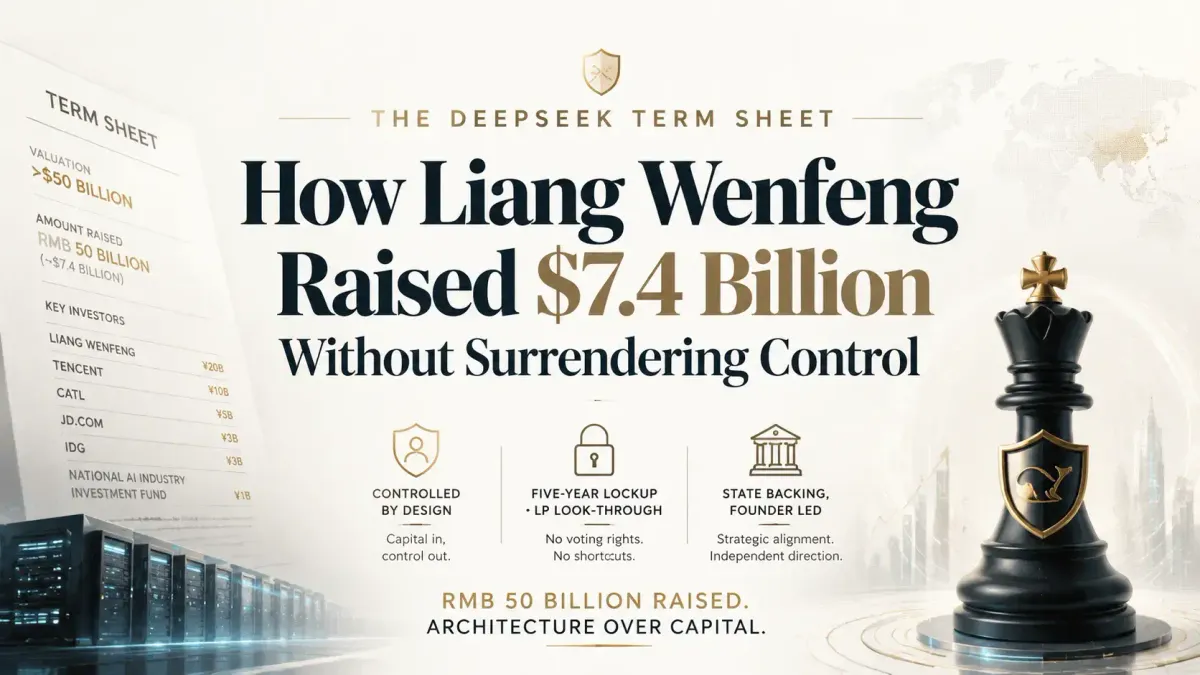
DeepSeek has closed its first external funding round: RMB 50 billion (~$7.4 billion) at a valuation above $50 billion — the largest single round in China's AI industry to date. Reported by The Information on June 16.
The cap table: Liang Wenfeng personally ¥20B (the largest single check), Tencent ¥10B, CATL ¥5B, JD.com and IDG ¥3B each, and the National AI Industry Investment Fund ¥1B as a direct equity investment.
For global investors, the dollar number is not the story. The deal architecture is.
The Three-Layer Control Firewall
Layer 1 — Capital Routed Through a Founder-Managed LP
Per the report, every external investor except the National AI Fund was required to commit capital not to DeepSeek directly, but to a limited partnership managed by Liang Wenfeng himself. These investors receive economic interest, preferential rights in future rounds, and elevated financial disclosure — but no voting rights at the company level. Strategy, technology direction, and corporate decisions remain entirely with Liang.
Layer 2 — Five-Year Lockup + LP Look-Through
Most investors face a five-year lockup, during which holdings cannot be sold. In an industry whose typical fund cycle is far shorter, this filters out short-duration arbitrage capital by design.
DeepSeek additionally requires look-through identification of every underlying LP in each fund vehicle, to prevent equity from ultimately flowing to undisclosed parties.
Layer 3 — The State Carve-Out
The single exception: the National AI Industry Investment Fund invested ¥1B directly into DeepSeek's equity, with voting rights and no lockup. Small enough to be non-dilutive to Liang's control; structurally significant in signaling DeepSeek's recognized position within China's AI industrial system.
The Pre-Round Setup
This was prepared in advance. On April 27, DeepSeek's registered capital was raised from ¥10M to ¥15M, Liang's direct stake increased from 1% to 34%, and through direct and indirect holdings he now controls approximately 84.29% of the company. The firewall was built before investors entered the room.
Why This Was Even Possible
DeepSeek was founded in 2023 inside Liang's quantitative hedge fund High-Flyer (幻方量化). Until R1 went viral in early 2025, DeepSeek had taken no external equity capital and had not followed the standard VC trajectory of Chinese model startups. It looked more like a research-oriented model lab: small team, low external pressure, open-source orientation, and a focus on model efficiency.
For nearly three years, DeepSeek operated on a zero external equity principle — R&D, GPU procurement, and compensation costs were absorbed entirely by High-Flyer's operating earnings.
High-Flyer's scale matters: at peak it managed over ¥70B AUM, and its 2025 product lineup posted an average return of 56.55%. This cash flow continuously funded DeepSeek's supercomputing cluster build-out and large-model pre-training spend.
The single most important fact for global investors: DeepSeek did not need this round to survive. It chose to raise. That choice is what made the term sheet possible.
The trigger was talent attrition, not capex. The Information notes DeepSeek has lost core researchers: Luo Fuli, an important V3 contributor, joined Xiaomi; Guo Daya, a researcher involved in earlier model R&D, joined ByteDance at higher compensation. Public information suggests at least five core R&D personnel have departed, spanning foundation models, reasoning, OCR, and multimodal — the four core technical lines.
Financing became unavoidable. Liang's answer: raise, but control.
Where the Money Goes
Two strategic vectors, both visible from DeepSeek's own hiring posts.
1. From Leasing to Owning Compute
DeepSeek is hiring at the Wulanchabu (Inner Mongolia) intelligent computing center and has opened a new "IDC Design & Planning Engineer" role responsible for the planning and construction of MW-to-GW-scale ultra-large intelligent computing centers. The implication: DeepSeek is moving from leased GPU capacity to owned data centers.
The signal is clear: DeepSeek does not intend to remain a "model company." It intends to be an owner of AI infrastructure — lower long-term compute cost, higher scheduling efficiency, absolute control of core resources.
2. From Model to Agent
A new "Agent Harness" team, led by senior researcher Chen Deli , is being assembled to build DeepSeek Code Harness, explicitly benchmarked against Anthropic's Claude Code. Hiring posts make the architecture explicit:
Model + Harness = Agent
Everything outside the model — context management, tool calling, file I/O, terminal execution — is consolidated under Harness. This is less a routine team expansion and more the first organizational signal of DeepSeek's strategic shift from model company to product company.
The reference points cited in the report: Claude Code has built an AI Coding business with annualized revenue exceeding $2.5B, and OpenAI's Codex grew weekly active users from 3M to 4M in 15 days. DeepSeek does not intend to fall behind.
The Industry Backdrop the Report Frames
A few data points the report uses to position DeepSeek's competitive standing:
- Call volume: Per OpenRouter, DeepSeek-V4-Flash has been #1 globally for three consecutive weeks at 3.69 trillion tokens per week. Four of the global top five are Chinese models. Chinese models have collectively led global weekly call volume for six consecutive weeks.
- Pricing posture: Against industry-wide price hikes — Zhipu raised API prices three times this year, each above 30%; Tencent Cloud CodeBuddy enterprise edition +154%; Alibaba Cloud compute products +5–34% — DeepSeek instead announced a permanent 75% price cut on V4-Pro. Cache-hit pricing of ¥0.025 per million tokens is, per the report, approximately 1/14,960 of GPT-5.5's long-context tier.
- User scale: Per QuestMobile, as of March 2026 DeepSeek MAU was approximately 127M, third in industry. May web visits reached 541M, +11.22% MoM, ranking #1 in China and #5 globally.
The synthesis the report draws: while peers raise prices and overseas leaders see call volume slip, DeepSeek is redefining the competitive rules of large models with a combination of extreme cost-performance plus open-source ecosystem.
Why This Round Matters Beyond DeepSeek
The report frames Liang's deal as "anti-capital" in the literal sense. The conventional logic is: founders take money, investors take rights — the more money, the more rights. Board seats, veto powers, liquidation preferences. Liang inverted that script.
He placed investors in a "capital in, control out" cage: five-year lockup, no voting rights, capital not entering the company entity directly. By the report's framing, this is not financing — it is borrowing without interest, on the condition that lenders cannot interfere.
His ¥20B personal commitment draws a red line for every external investor: even if all external investors combined, they could not out-commit Liang alone. He is both the rule-maker and the largest chip-holder.
The National AI Fund is placed with surgical precision: ¥1B direct, with vote, no lockup — sufficient for the strategic role, insufficient to dilute control. The report calls this "limited openness, precision concession" — a combination of political and commercial wisdom.
The five-year lockup plus LP look-through together broadcast: this company is not your arbitrage instrument.
The Honest Caveats the Report Names
External capital, even non-voting, changes governance. DeepSeek built its identity as a research-oriented model lab; whether it can preserve that technical idealism after commercial capital enters is, in the report's words, "a question only time can answer."
Talent attrition will not stop because of a single round. The pressure on core researchers continues regardless of capital structure.
The Read for Global Investors
Two takeaways consistent with what the report itself argues.
First, this is not a financing story — it is a story of holding the line on initial conviction inside a capital flood. DeepSeek's defining feature is that it never needed VC to survive. High-Flyer's cash flow gave Liang the leverage to be selective, to set thresholds, and to write the rules. Ordinary founders do not have this option. Liang did.
Second, the round transmits a signal to the wider industry: financing does not have to mean losing control — provided you have enough chips and a clear bottom line. ¥50B proves DeepSeek's commercial value. The architecture proves the company still belongs to Liang.