CATL Announces China's Largest-Ever Share Buyback: A RMB 20–40 Billion Cancellation Signal to the World
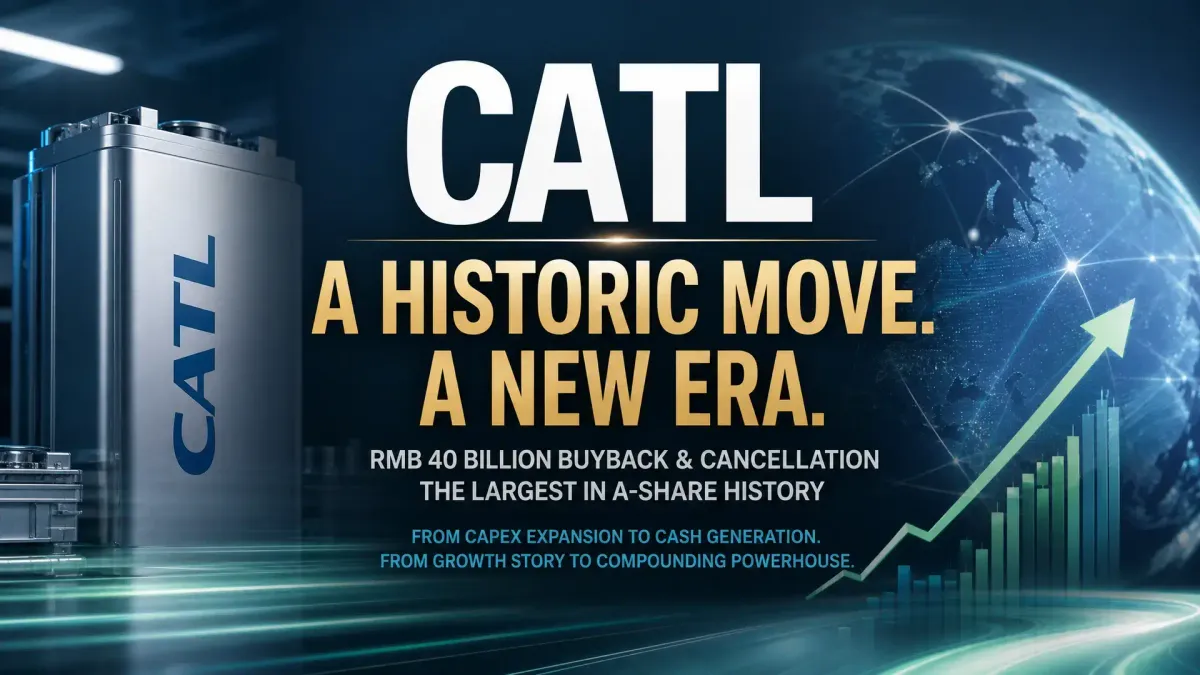
CATL has launched a historic RMB 40B share buyback and cancellation program, the largest in A-share history. By permanently reducing share count, the battery giant signals a structural shift in corporate governance for global allocators.

Introduction
all repurchased shares will be fully canceled, marking a historical milestone for shareholder return programs in the history of the A-share market.
For global and North American institutional investors—who have long scrutinized Chinese mega-caps on governance, capital efficiency, and return-on-capital discipline—this marks a definitive structural pivot: from capital-consuming expansionists to value-distributing mature industry leaders.
Key Details of the Buyback Program
| Item | Details |
|---|---|
| Repurchase Scale | RMB 20–40 billion (~USD 2.8–5.5B) |
| Purpose | Full share cancellation; reduces registered capital |
| Funding Source | Internal self-owned cash reserves |
| Precedent | Largest single-round buyback in A-share market history |
Unlike traditional Chinese buybacks—often directed into employee stock ownership plans (ESOPs) or treasury stock that can eventually be re-issued and dilute public shareholders—a direct cancellation permanently reduces the outstanding share count, automatically boosting earnings per share (EPS) and net asset value (NAV) per share for all remaining investors.
Deep Analysis: Why This Matters to Global Investors
1. A Paradigm Shift in Chinese Corporate Governance
Western institutional investors are accustomed to mega buyback-and-cancellation programs from U.S. tech giants like Apple and Microsoft, which consistently use free cash flows to support stock valuations. Chinese companies have historically preferred retaining cash or reinvesting in capacity expansion—sometimes leading to overcapacity and declining ROIC—earning them a "governance discount" from foreign fund managers.
CATL's move signals that leading Chinese industry champions are now aligning with global institutional standards of capital discipline. This is particularly appealing to North American pension funds and long-only equity managers that demand shareholder-friendly capital allocation as a prerequisite for portfolio inclusion.
2. The Message: Peak Capex Is Behind, Free Cash Flow Is Here
By deploying a war chest of this magnitude on its own shares, CATL is sending two unambiguous signals:
- Peak capex is past. CATL's major global manufacturing hubs are fully operational. The company has exited the cash-burning greenfield construction phase and is now entering a free-cash-flow harvesting cycle with high earnings visibility.
- Management believes the stock is undervalued. When a company cancels—rather than simply holds—repurchased shares, it is the most powerful form of capital return. It reflects ultimate management confidence in the company's long-term intrinsic value.
3. Strategic Relevance: The IRA-Proof Business Model
For North American investors navigating Inflation Reduction Act (IRA) eligibility barriers and geopolitical headwinds, CATL has pioneered an asset-light global expansion strategy through its "LRS" model (Licensing, Royalty & Services)—exemplified by its landmark technology licensing partnership with Ford Motor Company. This model monetizes CATL's intellectual property in the U.S. market without requiring direct capital-heavy factory investments. The buyback reinforces the long-term sustainability and profitability of this model.
Conclusion
CATL's RMB 40 billion buyback-and-cancellation plan is a watershed moment for the A-share market and for the global green-energy investment narrative. It transforms CATL's investor profile from a high-beta growth stock into a high-quality, cash-generating compounder with institutional-grade shareholder return mechanics. For global asset managers seeking exposure to the energy transition, the signal is clear: China's battery hegemon has entered its compounding era.