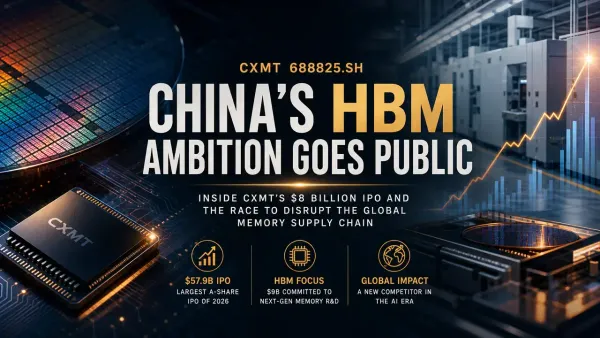
CXMT's RMB 580 Billion STAR Market Debut: The IPO That Could Redraw the Global DRAM Map
On July 27, 2026, memory giant CXMT launched its historic RMB 580B STAR Market IPO. Earmarking capital for sub-20nm DRAM and HBM lines, CXMT is positioned as a key bellwether for China's self-sufficient AI hardware supply chain.

Introduction
The global semiconductor sector is watching closely as Changxin Memory Technologies (CXMT), operating under its listed parent Changxin Technology (Shanghai Stock Exchange STAR Market), officially launched its Initial Public Offering on Monday, July 27, 2026. With an IPO issue price of RMB 8.66 per share, the post-listing total market capitalization is valued at RMB 579.19 billion (approximately USD 80 billion).
As China's national champion in Dynamic Random-Access Memory (DRAM) manufacturing, CXMT's public debut represents one of the largest technology IPOs globally in 2026—and it is set to redraw the competitive landscape of the global memory chip industry, with direct implications for Samsung Electronics, SK Hynix, and Micron Technology (NASDAQ: MU).
The Global DRAM Oligopoly—And the New Challenger
DRAM is the foundational memory component powering everything from smartphones and laptops to AI inference servers and autonomous vehicles. For decades, this market has been a near-impenetrable oligopoly:
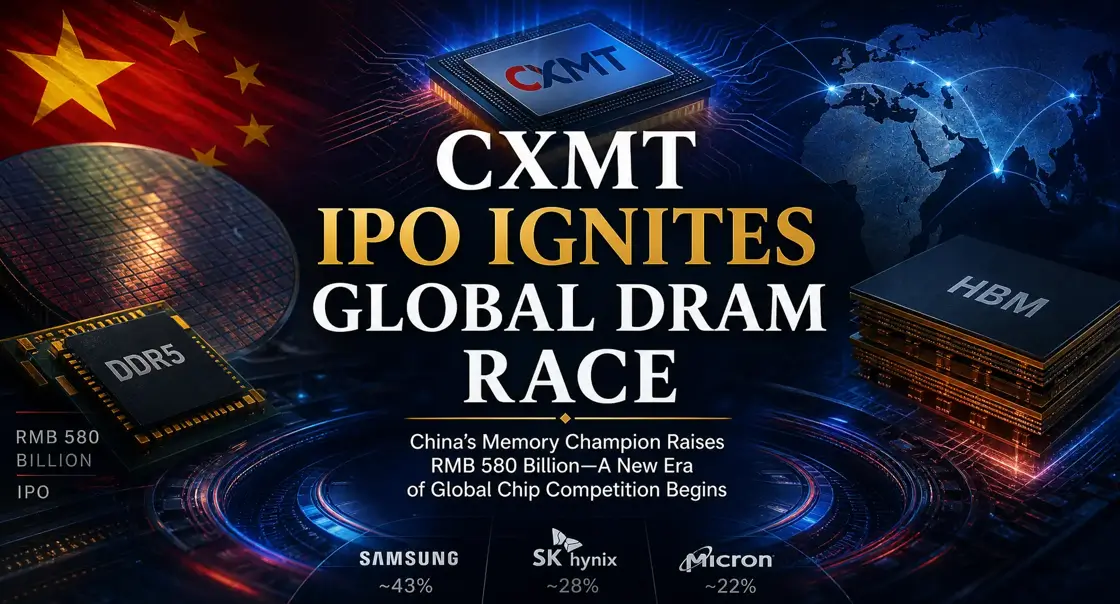
| Company | Estimated Global DRAM Market Share |
|---|---|
| Samsung Electronics | ~43% |
| SK Hynix | ~28% |
| Micron Technology | ~22% |
| Others (incl. CXMT) | ~7% |
CXMT was established as China's strategic answer to this structural foreign dependency. Its mandate: build a fully integrated, domestically controlled DRAM design and manufacturing powerhouse. In the past three years, CXMT has achieved mass production of DDR4, LPDDR4X, and is now scaling DDR5 and LPDDR5 to meet the explosive demands of the AI infrastructure buildout.
Deep Analysis: Why This IPO Matters Beyond China's Borders
1. The HBM Race: CXMT's Most Critical Frontier
The single most consequential technology frontier for CXMT—and for the global chip supply chain—is High Bandwidth Memory (HBM). HBM is the essential hardware that feeds data to NVIDIA and AMD GPUs in AI data centers; without it, AI scaling hits a hard wall. The current global HBM supply is almost entirely controlled by SK Hynix, Samsung, and Micron.
CXMT's active development of HBM-capable packaging and process technology is being monitored with extreme attention by global tech fund managers. If CXMT achieves credible HBM production at scale, it introduces a fourth major supplier into one of the most profitable, supply-constrained segments in the semiconductor industry—a direct catalyst for DRAM pricing dynamics worldwide.
2. The "Siphon Effect" and Market Structure
A RMB 580 billion market-cap listing is never a quiet event. In the week preceding the CXMT IPO, domestic trading volumes across the Shanghai and Shenzhen markets contracted visibly—dropping below RMB 2 trillion for the first time in over three months. Market analysts attribute part of this contraction to institutional and retail investors pre-allocating capital for CXMT participation. On the subscription side, only 0.17% of retail allocations were ultimately forfeited, signaling extraordinary domestic confidence in the stock's strategic value and near-term price performance.
3. Geopolitical Resilience: The Real Test
CXMT's entire growth narrative has unfolded under the most severe semiconductor export control regime in history—covering advanced lithography equipment from ASML (Netherlands), Applied Materials and Lam Research (U.S.), and Tokyo Electron (Japan). Despite these constraints, CXMT has maintained production ramp schedules through a combination of:
- Domestic supply chain substitution (emerging Chinese SME vendors)
- Multi-pass patterning techniques to compensate for EUV restrictions
- Optimization and extension of existing installed toolsets
The IPO proceeds will fund the next phase of Hefei fab expansion. Global investors treat CXMT as the primary bellwether for China's semiconductor self-sufficiency campaign. A successful DDR5 and HBM yield ramp—under continued export control pressure—would be the clearest proof yet that technology containment has material limits.
4. Risk Factors for Global Memory Investors
For fund managers holding long positions in Micron, SK Hynix, or Samsung, CXMT's capacity ramp presents a well-defined risk scenario:
- Legacy and mid-range DRAM oversupply: Chinese domestic capacity, incentivized by state subsidies, could flood commodity DRAM segments, compressing average selling prices (ASPs) for established players.
- AI-grade memory insulation: HBM and advanced LPDDR5 segments remain relatively insulated in the near term, given the technical complexity of yield qualification.
- Subsidy-driven competition: CXMT benefits from significant state support, making a direct cost-to-cost comparison with Samsung or Micron misleading without adjusting for implicit government subsidies.
Conclusion
CXMT's RMB 580 billion STAR Market IPO is simultaneously a capital markets event, a geopolitical statement, and a technological proof-of-concept. For global technology investors, it is neither a story to ignore nor a straightforward buy signal—it is a structural force that will reshape DRAM supply dynamics over the next 12 to 24 months. Whether it compresses margins at Micron or opens new pricing equilibria in the AI memory stack, CXMT's trajectory deserves a permanent place in any serious global chip investment framework.