CXMT's $9.8 Billion IPO: A Watershed Moment for China's Semiconductor Self-Reliance
CXMT, China's largest DRAM maker, is preparing for a historic $9.8B IPO. Driven by the AI boom and US export controls, this listing offers global investors exposure to China's tech decoupling, balanced by persistent regulatory risks.

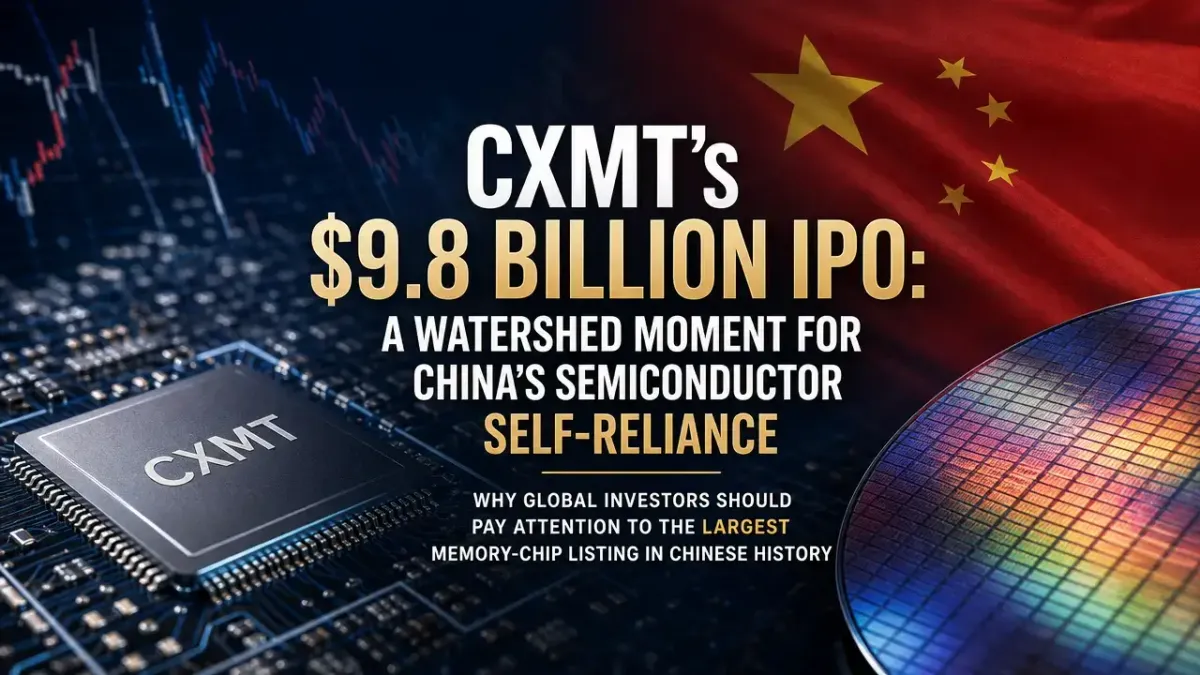
Why global investors should pay attention to the largest memory-chip listing in Chinese history
ChangXin Memory Technologies (CXMT), China's largest DRAM manufacturer, is preparing to launch what could become the country's second-biggest initial public offering on record—a deal valued at approximately $9.8 billion. For global investors, particularly those in North America tracking the evolution of the global semiconductor landscape, this is not merely a capital markets event. It is a signal of how the world's second-largest economy is accelerating its push for technological independence in one of the most strategically sensitive sectors of the modern economy.
The Deal in Context
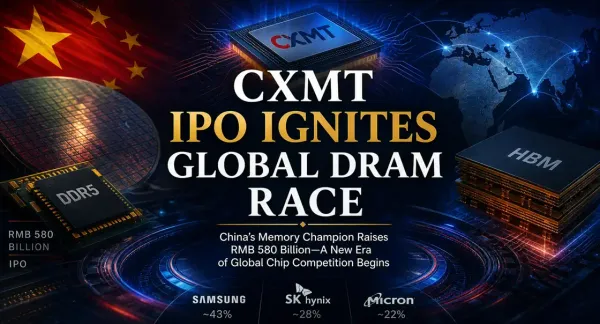
The timing is no accident. Global demand for memory chips is surging, driven by the massive infrastructure build-out underpinning artificial intelligence. AI servers require exponentially more high-bandwidth memory (HBM) and traditional DRAM than conventional data centers. Samsung, SK Hynix, and Micron have long dominated this market. CXMT's IPO arrives precisely as Western sanctions and export controls have made China's access to advanced memory technology increasingly constrained—and Beijing's resolve to build domestic alternatives increasingly explicit.
The $9.8 billion target, if achieved, would rank just behind the historic listings of state-owned mega-banks in China's modern IPO history. More importantly, it would provide CXMT with the capital firepower to expand capacity, fund research and development, and potentially challenge the incumbent oligopoly in a market that has been notoriously difficult for new entrants to penetrate.
From Silicon Valley Garage to National Champion
CXMT's founder, Zhu Yiming, represents a generation of Chinese technocrats who blend Western engineering training with state-backed industrial ambition. Reports indicate that Zhu refused to draw a salary until the company became profitable—a detail that resonates in investor circles as either genuine alignment with shareholders or savvy political theater in an economy where state support often blurs the line between commercial and strategic objectives.
The company's trajectory mirrors China's broader semiconductor strategy: identify a chokepoint technology, pour state and private capital into it across a decade-long horizon, and accept near-term losses in pursuit of long-term supply chain security. DRAM is particularly challenging because it is a commodity product where scale, yield rates, and manufacturing process node advancement determine winners. CXMT has reportedly made progress on older process nodes but still lags Samsung and SK Hynix by several generations on the most advanced chips.
What This Means for Global Portfolios
For North American investors, CXMT presents a complex risk-reward calculus. On one hand, the company operates in a sector that the U.S. government has explicitly designated as strategically sensitive. Additional sanctions or entity-list designations remain a live risk. On the other hand, the AI-driven memory demand cycle is structural, not cyclical. AI capital expenditure is projected to maintain a compound annual growth rate of approximately 50 percent through 2030, according to domestic fund managers cited in recent market analysis. A significant portion of that demand will come from Chinese hyperscalers—Alibaba, ByteDance, Tencent, Baidu—who are under explicit government pressure to source domestically where possible.
The IPO also carries implications for global memory pricing. If CXMT successfully scales production over the next three to five years, the incremental supply could moderate the extreme price volatility that has characterized DRAM markets historically. Alternatively, if yield rates disappoint or advanced-node development stalls, the company could become a persistent capital sink—absorbing state subsidies without achieving commercial viability.
The Bottom Line
CXMT's listing is a window into how China is financing its technological decoupling from Western supply chains. For global investors, it offers exposure to a potentially transformative player in a $100 billion-plus market, but one where geopolitical risk is as material as commercial risk. The deal's reception—subscription ratios, foreign participation, and post-listing performance—will be closely watched as a barometer of international appetite for Chinese hard-tech assets amid an increasingly fragmented global economy.