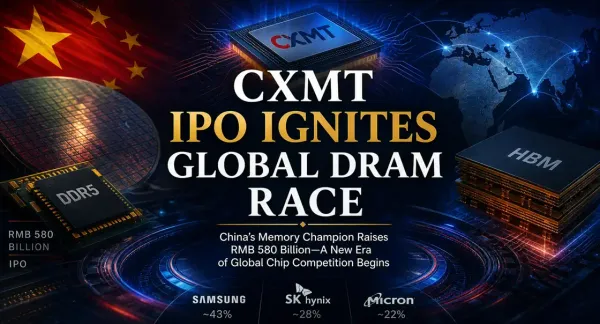
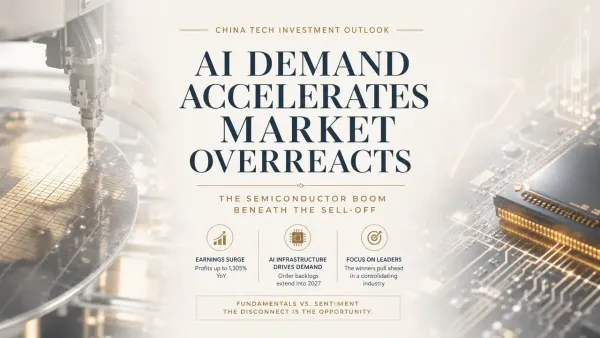
China's Memory Chip Sector Explodes: Jiangbolong Posts 62,000× Profit Surge as DRAM Supercycle Gains Momentum
China's memory chip sector is undergoing an earnings supercycle. Driven by robust AI demand and Samsung's planned 20% Q3 DRAM price hike, storage manufacturer Jiangbolong pre-announced a staggering H1 net profit surge of over 62,000% YoY.

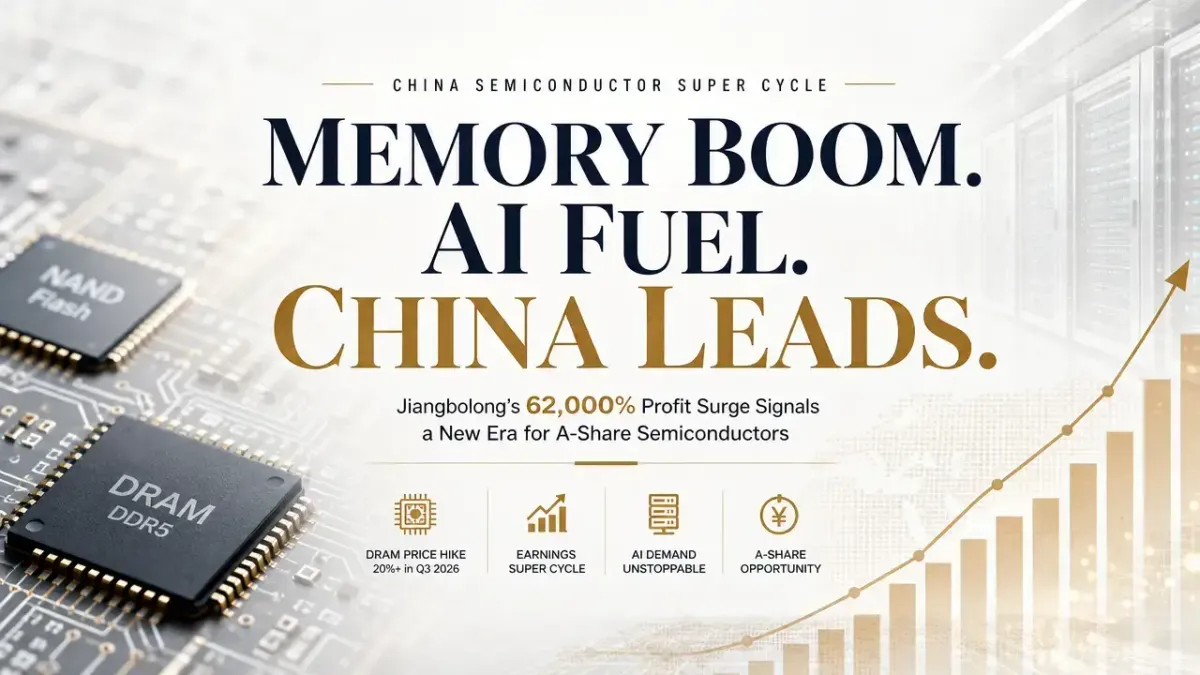
If you need one data point to understand the scale of the ongoing memory chip supercycle hitting China's A-share semiconductor sector, consider this: Jiangbolong Electronic Technology (江波龙, SZ: 301308), one of China's leading NAND flash and DRAM module manufacturers, pre-announced first-half 2026 net profit of RMB 9.2–11.0 billion — a year-on-year increase of 62,204% to 74,394%. That is not a typo. The company earned more profit in six months than it had accumulated over most of its corporate history.
Jiangbolong's stunning result is not an isolated anomaly. It is the most dramatic headline in a broad-based earnings revival sweeping through China's semiconductor and memory value chain on the back of AI-driven demand, disciplined global supply, and sharp DRAM price increases.
The Numbers Behind the Story
Jiangbolong's H1 2026 earnings pre-announcement, released July 5, put net profit in the range of RMB 9.2–11.0 billion (approximately USD 1.27–1.52 billion). For context, the company reported near-zero or negative profits through much of 2023–2024 during the last memory downturn. The turnaround is being driven by a combination of factors: higher average selling prices (ASPs) for NAND and DRAM products, surging demand from AI server deployments and data center build-outs, and the company's growing position in high-value storage modules sold to enterprise and AI infrastructure customers.
Beyond Jiangbolong, the broader A-share semiconductor earnings season is painting a consistently bullish picture:
- Yongding Co. (永鼎股份): H1 2026 net profit forecast up 57–120% YoY, driven by fiber optics volume and pricing gains tied to AI infrastructure.
- Dongfang Shenghong (东方盛虹): H1 net profit expected up 987–1,194% YoY, with petrochemical margin expansion as a secondary but notable data point on Chinese industrial earnings momentum.
- Guotai Haitong Securities (国泰海通): H1 profit RMB 20.0–20.5 billion, up 164–171% YoY — a new record half-year high — reflecting how a rising stock market is generating windfall gains across China's brokerage sector.
The DRAM Price Hike Catalyst
The memory sector's earnings surge is not merely backward-looking. Fresh intelligence from the supply chain is pointing to continued price pressure through Q3 2026 and beyond. According to industry sources, Samsung Electronics has notified major customers of a planned 20% increase in DRAM average selling prices for Q3 2026 — with oral notifications already delivered to consumer electronics manufacturers in China. Spot price data from Huaqiangbei, China's largest electronics wholesale market in Shenzhen, confirms the trend: DRAM modules and SSDs from Samsung, Kingston, and SanDisk have all seen notable price increases in recent weeks.
This pricing dynamic is structural, not cyclical. On the demand side, AI model training and inference are driving insatiable appetite for High Bandwidth Memory (HBM) and DDR5, while hyperscaler capex plans remain robust. On the supply side, leading-edge DRAM capacity remains constrained — Micron's major HBM expansion at its Hiroshima facility will not ship until 2028. Meanwhile, Huawei's semiconductor research arm published an updated version of its "Tao's Law" chip scaling theory on July 3, signaling continued Chinese ambition in next-generation semiconductor architecture — a long-term tailwind for domestic chip demand.
The A-Share Angle: Who Benefits?
For North American investors looking at China equity exposure, the memory upcycle is playing out across multiple A-share sub-sectors:
- Storage manufacturers: Jiangbolong (301308) is the most direct play on the NAND/DRAM price cycle in the domestic market.
- Semiconductor equipment: Chinese equipment makers are benefiting from accelerated domestic fab investment as Chinese chipmakers race to reduce reliance on foreign suppliers. The narrative of semiconductor self-sufficiency continues to drive capital allocation.
- AI infrastructure components: Optical transceiver maker Zhongji Innolight (中际旭创, 300308) cleared up market rumors on July 5, confirming that Corning's glass bridge technology is not a replacement for its optical module products — a reassurance that briefly stabilized its stock after weeks of volatility.
- Passive components: Global passive component maker Yageo (国巨) announced a full-lineup capacitor price increase, covering MLCCs, aluminum electrolytic capacitors, tantalum capacitors, and more — confirming that the electronics supply chain price escalation is broadening beyond memory.
The Risk to Watch
The A-share semiconductor trade is not without its landmines. U.S.-listed memory stocks — Micron, SK Hynix — experienced sharp selloffs in late June/early July on concerns about AI capex rationalization. On July 3–4, the Philadelphia Semiconductor Index fell over 6%, dragging A-share sentiment lower at the open on July 6 before domestic earnings data reasserted bullish momentum. The key risk is that institutional money in A-share semiconductor stocks has become extremely crowded: many names doubled or tripled in a matter of weeks, and "buy the rumor, sell the news" dynamics are now visibly at play. Investors should distinguish between names that have delivered actual earnings versus those running purely on AI narrative.
The Bottom Line
China's memory and semiconductor sector is living through a genuine earnings supercycle, turbocharged by AI demand and supply discipline. For North American investors with China exposure, this is arguably the single most important sector story in A-shares right now. The challenge is valuation and positioning — but the fundamental direction of travel is unambiguous.