China's AI Inflection Point: Kimi K3, DeepSeek's $50B Tag, and the Humanoid Production Line
At WAIC 2026, China's AI stack showed massive integration. Driven by Moonshot's Kimi K3 and DeepSeek's $50B valuation, the robust momentum contrasts with the July 17 A-share tech dip, opening a tactical window for cheap China AI stocks.

Shanghai's WAIC 2026 isn't just a trade show. It's a signal that China's AI stack is vertically integrating faster than global portfolios have priced in.
The 2026 World Artificial Intelligence Conference opened in Shanghai on July 17 with President Xi Jinping delivering the keynote address—a level of political signaling that tells you Beijing views AI not as a sector bet, but as a national strategic priority. This year's exhibition features over 300 debut products, but three data points released in the 48 hours surrounding the opening are what global investors should focus on: a 2.8-trillion-parameter open-source model, a $50 billion valuation for DeepSeek, and a humanoid robot production run-rate that has tripled in 18 months.
The Model Race: Kimi K3 Goes Global
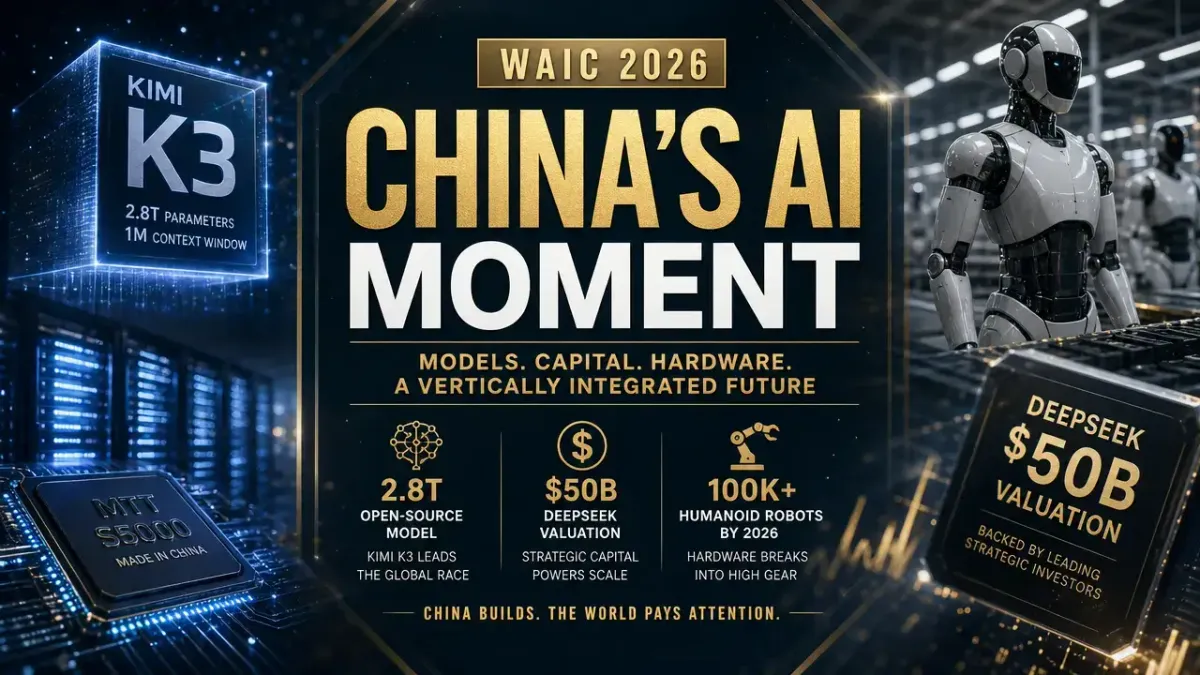
At midnight on July 17, Moonshot AI (月之暗面) officially unveiled Kimi K3, a 2.8-trillion-parameter large language model with a 1-million-token context window. It is now the largest open-source model by parameter count globally, and the first to cross the 2-trillion threshold.
The technical architecture matters. K3 is built on Kimi Delta Attention (KDA) and Attention Residuals (AttnRes), designed to improve information flow across longer sequences and deeper model layers. It employs a Mixture-of-Experts (MoE) architecture with 896 experts, activating 16 per forward pass. Moonshot claims these structural improvements deliver a 2.5x efficiency gain over K2 in converting compute into capability.
Benchmark results are competitive. In software engineering, knowledge work, and deep-reasoning evaluations, K3 ranks behind only Claude Fable 5 and GPT-5.6 Sol globally. On coding-specific tasks—arguably the most commercially relevant benchmark for enterprise adoption—K3 outperforms Claude Fable 5 on multiple benchmarks and excels at long-horizon software engineering tasks, large-codebase comprehension, and autonomous tool orchestration. Moonshot explicitly notes the model is designed for game development, front-end engineering, CAD workflows, and infrastructure optimization.
The commercial trajectory is equally striking. Moonshot has completed six funding rounds in 2026 alone. Its previous round closed at a $20 billion valuation on June 30, and a new round is already underway at a $31.5 billion pre-money valuation. Annual recurring revenue (ARR) crossed $300 million in mid-June, up from $100 million in March and $200 million in May. API revenue now accounts for over 70% of total sales. Overseas paid users and API revenue have both grown 400%, with the product deployed in over 200 countries and regions.
DeepSeek's $50 Billion Revelation
While Moonshot grabbed headlines with its model launch, DeepSeek provided the capital-markets story. On July 16, luggage manufacturer Kairun Co. (300577.SZ) disclosed in an affiliated-investment filing that its subsidiary had invested 40 million yuan into an LP vehicle that holds a 0.8265% indirect stake in DeepSeek. The math is revealing: the filing implies a post-money valuation of approximately 350.9 billion yuan, or roughly $50 billion.
DeepSeek has not disclosed revenue or profit figures, citing commercial confidentiality. But the cap table tells a story of strategic conviction. Its Series A holding vehicle, Hangzhou Chengli, counts CATL, NetEase, JD.com, Tencent, and multiple institutional investors as backers. DeepSeek is also pivoting from a pure research house into an integrated "model + compute + chip" player: it is building its own data center in Inner Mongolia and developing proprietary AI inference chips.
The capital intensity of this pivot is enormous. Domestic peers including Zhipu and MiniMax have also launched large funding rounds in recent weeks to expand compute infrastructure. China's large-model sector has entered a "heavy asset" phase where capital, not just algorithmic talent, is the primary moat.
Hardware: GPUs and Humanoids
The AI story isn't limited to software. GPU designer Moore Threads (688795) released H1 2026 guidance on July 16, forecasting revenue of 1.65–1.75 billion yuan, up 135–149% year-over-year. Its flagship MTT S5000 training-and-inference GPU has reached mass production and is already deployed in clusters capable of training trillion-parameter models. The company went public on the STAR Market in December 2025 and currently carries a market capitalization of 305 billion yuan.
On the robotics front, Vice Minister of Industry and Information Technology Ke Jixin disclosed on July 16 that China's humanoid robot output reached roughly 20,000 units in 2025, surpassed 40,000 in the first half of 2026, and is projected to exceed 100,000 for the full year. Ke characterized the next two to three years as a "critical inflection point, even a new starting line" for the industry.
Market Reaction: The Disconnect
Here is where global investors need to pay attention. Despite these fundamental breakthroughs, the A-share technology complex sold off sharply on July 17. The ChiNext Index dropped 4.33%, the STAR Market Composite fell 3.70%, and the STAR Chip ETF declined nearly 5%. Demingli, a storage-chip designer, posted its third consecutive limit-down. Precious metals and AI hardware names led the decline.
This disconnect between technological momentum and near-term market sentiment is not unusual for China's growth sectors. It creates a tactical entry window for investors with a 12- to 24-month horizon.
Implications for Global Portfolios
- Semiconductor equipment and AI infrastructure are the most direct beneficiaries. The vertical integration trend—model houses building their own chips and data centers—means demand for domestic foundry capacity, advanced packaging, and cooling solutions will remain structurally elevated.
- Robotics supply chain names are still early-cycle. With humanoid output scaling from 20k to 100k units in two years, precision gearboxes, torque sensors, and harmonic drives are the picks-and-shovels play.
- Application-layer software (enterprise AI, gaming, front-end automation) should see accelerating adoption as model capabilities cross the threshold where API-based deployment becomes cheaper than human labor for an expanding set of tasks.
Risk Factors
- US export controls on advanced semiconductors remain the single largest exogenous risk. If further restrictions are placed on cloud-computing access or chip-design tools, China's AI scaling curve could flatten.
- Valuation discipline: DeepSeek at $50 billion with undisclosed financials, and Moonshot at $31.5 billion on $300 million ARR, reflect venture-market optimism that may not survive a liquidity contraction.
- Domestic market sentiment: The July 17 sell-off shows that even strong fundamentals can be overwhelmed by short-term risk-off flows in China's retail-dominated market.
Bottom Line
WAIC 2026 confirms that China's AI ecosystem has moved from catch-up mode to genuine competitiveness in model scale, open-source distribution, and hardware integration. For global investors, the question is no longer whether China can build competitive AI; it is whether the current valuation discounts in the A-share tech complex adequately reflect that capability. On today's prices, the answer appears to be no.