China Overhauls A-Share Trading Rules: What the July 6 Reform Means for Global Investors
On July 6, 2026, China rolled out sweeping trading upgrades. By expanding after-hours fixed-price trading to all A-shares, aligning fund closing, and doubling ST limits to ±10%, Beijing is lowering execution friction for global allocators.

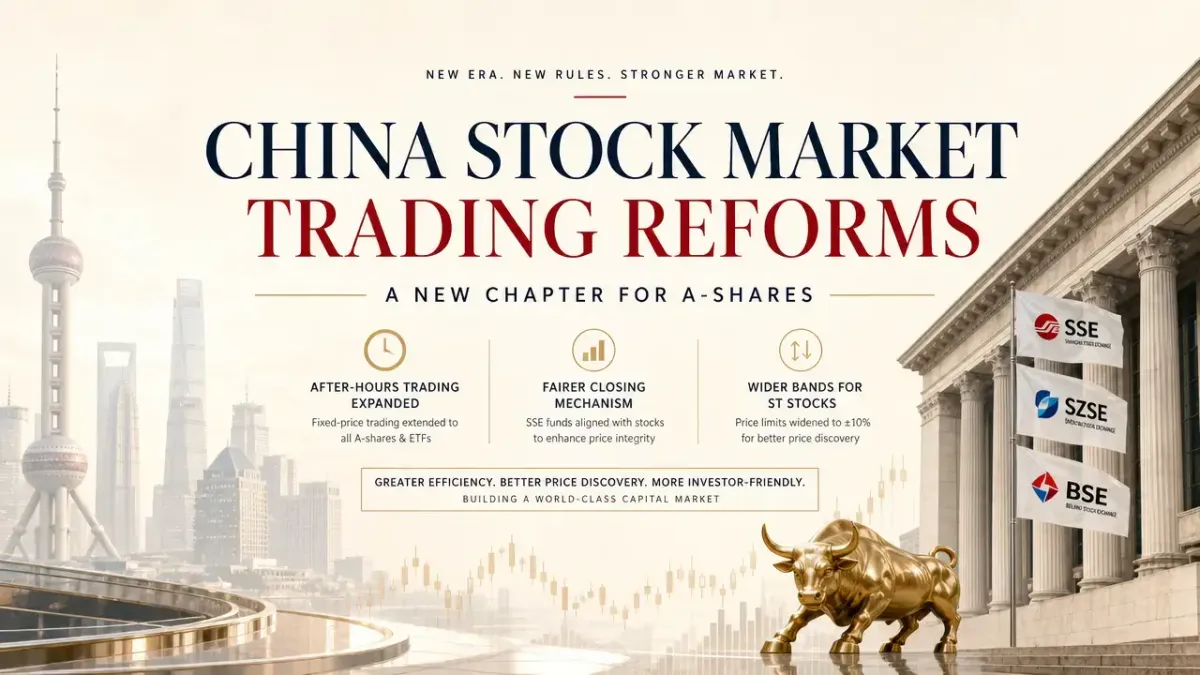
China's three major stock exchanges — the Shanghai Stock Exchange (SSE), Shenzhen Stock Exchange (SZSE), and the Beijing Stock Exchange (BSE) — rolled out a sweeping set of trading rule upgrades on July 6, 2026, marking one of the most significant structural reforms to mainland equity market mechanics in recent years. For North American investors watching China's capital markets, the changes signal a deliberate push toward greater market efficiency, improved price discovery, and an investor-friendlier trading environment.
After-Hours Fixed-Price Trading Expands to All A-Shares and ETFs
The centerpiece of the reform is the dramatic expansion of the after-hours fixed-price trading (盘后固定价格交易) mechanism. Previously available only to stocks listed on the STAR Market (科创板), this session has now been extended to all A-share stocks and exchange-traded funds (ETFs) across both the SSE and SZSE. The BSE will follow at a later date.
Under this mechanism, investors may place or receive orders from 9:30 a.m. through 15:30, with actual matching taking place between 15:05 and 15:30 — after regular session close — at the official closing price. This is structurally similar to the "after-hours" sessions familiar to U.S. investors, though priced at the closing fix rather than via a live order book.
The practical implications are significant. Institutional investors managing large positions — such as index funds, ETFs, and long-only funds — can now execute sizable trades at the closing price without moving the market mid-session. Foreign institutions accessing A-shares via Stock Connect should find it meaningfully easier to execute index-rebalancing and portfolio adjustment orders with lower market-impact costs.
SSE Fund Closing Mechanism Aligned with Stocks
Previously, SSE-listed funds used a continuous auction in the final three minutes (14:57–15:00) to determine their closing price — a method that made funds susceptible to last-minute price manipulation and "window dressing." Under the new rules, this window now operates as a closing call auction (收盘集合竞价), identical to the mechanism used for individual A-share stocks. Orders cannot be canceled during this phase, and a single, unified closing price is produced. The change removes a structural information asymmetry that sophisticated traders were known to exploit, making the ETF pricing environment more equitable for passive, retail, and long-term investors alike.
ST-Designated Stocks Get Wider Price Bands
In arguably the most controversial change, the daily price limit for "Special Treatment" (ST and *ST) stocks on the main boards of both the SSE and SZSE has been doubled — from ±5% to ±10%, matching the limit applied to regular main-board stocks. Previously, the narrower band was intended to constrain volatility in financially distressed companies. Critics argued, however, that 5% limits actually trapped investors in low-quality shares and prevented efficient price discovery for companies undergoing delisting proceedings.
The reform reflects a broader regulatory philosophy: rather than artificially suppressing volatility in risky stocks, let market prices reflect risk more freely. For North American investors, this is a recognizable approach — U.S. markets impose no daily price limits at all. The change means ST stocks will now see more violent single-day swings, accelerating capital exit from companies on delisting watch.
Why This Matters for North American Investors
These reforms are consistent with China's multi-year effort to modernize its equity market infrastructure ahead of deeper global integration. For foreign institutional investors using Stock Connect to access A-shares, expanded after-hours trading reduces execution friction meaningfully. For those tracking China-linked ETFs listed in North America (such as KWEB, MCHI, or FXI), the changes improve the underlying benchmark's price quality. And for anyone managing China exposure in a global portfolio, a market that trades more like developed-market peers is a market that is incrementally easier to model, hedge, and trust.