China's Biopharma Sector Is Becoming the World's Drug Licensing Supermarket — And AstraZeneca Just Placed a $1.74 Billion Order
China's healthcare sector has rebounded 50% YTD in 2026, driven by global validation of its biotech assets. Highlighting this trend, AstraZeneca signed a landmark $1.74B siRNA deal with Shipharmaceuticals' subsidiary, Gigabio.

China's pharmaceutical sector has quietly staged one of the most dramatic sectoral reversals in A-share history. After four years of persistent underperformance, healthcare stocks are up approximately 50% year-to-date in 2026, on track for their best annual return since 2020. The driver is not domestic consumption — it is the recognition by global Big Pharma that Chinese biotech has become a world-class source of novel drug candidates.
The AstraZeneca–Shipharmaceuticals Deal
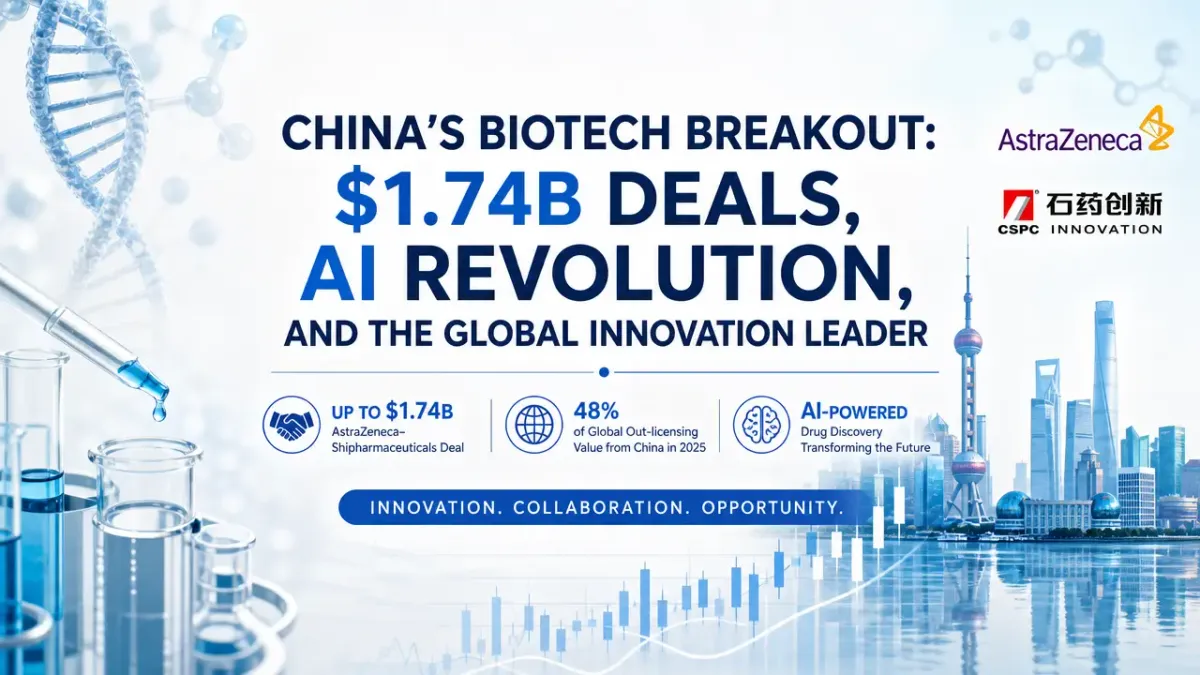
On July 2–3, 2026, Shipharmaceuticals Innovation (石药创新) announced a landmark strategic collaboration with AstraZeneca. Through its controlled subsidiary Gigabio (巨石生物), the company signed an agreement to co-develop novel siRNA (small interfering RNA) drug candidates targeting two undisclosed disease areas, with a focus on extra-hepatic delivery — one of the most technically challenging frontiers in RNA therapeutics.
The financial terms are substantial:
- Upfront payment: USD 30 million
- R&D milestone payments: up to USD 540 million
- Sales milestone payments: up to USD 1.2 billion
- Total potential value: up to USD 1.74 billion
This is not a one-off event. It is part of a sweeping wave of cross-border out-licensing deals that has made China the dominant source of innovative biotech assets globally.
The "Innovation Supermarket" Thesis
Jefferies Asia healthcare analyst Cui Cui has articulated what many institutional investors are now calling the "supermarket of innovation" thesis: in just the first 10 months of 2025, Chinese biotech companies accounted for 48% of total global out-licensing deal value — a figure that is both staggering and underappreciated outside Asia.
The structural reasons are clear:
- China has trained a massive cohort of Ph.D.-level scientists, many returning from U.S. research institutions
- The NMPA (China's FDA equivalent) has dramatically accelerated approval timelines
- China's cost structure allows clinical trials to be run at a fraction of Western costs
- Domestic capital markets (STAR Board, Hong Kong's 18A) now support pre-revenue biotech listings
The result: a production line of novel drug candidates — oncology biologics, RNA therapeutics, ADCs (antibody-drug conjugates) — that global pharmaceutical companies are buying rights to at record prices.
AI-Driven Drug Discovery as a Force Multiplier
The July 3 news flow also highlighted another deal that underscores the AI-pharma convergence: Insilico Medicine (英矽智能) signed a global strategic collaboration with Takeda Pharmaceutical, leveraging its end-to-end Pharma.AI platform to jointly advance drug candidates across multiple therapeutic areas. Insilico will lead AI-driven discovery; Takeda will handle global clinical development.
According to CITIC Securities, AI has now penetrated every core step of the drug development pipeline — target identification, virtual screening, de novo design, ADMET prediction, and automated synthesis — dramatically improving throughput and success rates. The global AI drug discovery market was approximately USD 2.49 billion in 2025 and is projected to exceed USD 46 billion by 2035, implying a CAGR above 33%. China is expected to be among the fastest-growing segments of this market.
What North American Investors Need to Know
- Valuation rerating is still early: The MSCI China Healthcare Index is up ~50% in 2026, recovering from a four-year bear market. Compared to the Nasdaq Biotech Index's valuations, Chinese biopharma is still attractively priced on a pipeline-adjusted basis.
- Out-licensing = cash flow + validation: Each major licensing deal does two things simultaneously — injects real USD-denominated cash into Chinese companies, and validates the scientific quality of their pipelines to a global audience. This is a self-reinforcing cycle.
- Key names: Shipharmaceuticals (石药集团/石药创新), WuXi AppTec (药明康德, SH: 603259), BeiGene (百济神州), and Zymeworks China partnerships are on institutional watch lists. WuXi AppTec specifically received multiple institutional "Gold Stock" nominations for July 2026.
- Risk factor: U.S. legislative risk around BIOSECURE Act-style restrictions on Chinese CROs/CMOs remains a key overhang. Investors should monitor Congressional activity closely.
Bottom Line
The era of dismissing Chinese biotech as a copycat industry is over. With nearly half of global out-licensing deal value originating in China, and with AstraZeneca writing a potential $1.74 billion check to a Chinese siRNA startup, the evidence is unambiguous. For North American investors, the question is no longer "is Chinese biopharma investable?" — it is "how much should be in my portfolio?"