China's AI Moment: How A-Share Tech Stocks Are Becoming the World's Most Cost-Efficient AI Play
As Chinese AI LLMs achieve technical parity with Western peers at 40-50% lower costs, Julius Baer has rated China tech overweight. Driven by the 15th Five-Year Plan, the A-share value chain offers secular growth at a deep valuation discount.


For North American technology investors, the artificial intelligence investment narrative has been synonymous with a handful of U.S. mega-caps. But a decisive shift is underway in China's A-share market — one that global asset allocators can no longer afford to ignore. According to Invesco, Julius Baer, and Bloomberg Intelligence, Chinese AI companies are rapidly closing the capability gap with Western peers, and doing so at a fraction of the cost. This convergence of technical parity and structural cost advantage is reshaping the global AI investment landscape.
The Cost-Efficiency Breakthrough
Chinese large language models (LLMs) and AI agent systems have achieved strong performance benchmarks in complex reasoning, code generation, and multi-modal tasks — directly competing with leading Western models in technical evaluations. Critically, this performance is being delivered at dramatically lower development and deployment costs, making Chinese AI solutions highly competitive for global enterprise customers, particularly in Asia, the Middle East, and emerging markets where cost sensitivity is paramount.
Julius Baer's Head of Asia Investment Management has stated explicitly: "Our favorite trade remains Chinese equities, particularly tech stocks. China has entered an AI capex upcycle that is driving earnings across the entire value chain." The firm currently holds an overweight rating on Chinese equities.
The Full AI Value Chain Investment Opportunity
The A-share AI investment opportunity spans three distinct layers:
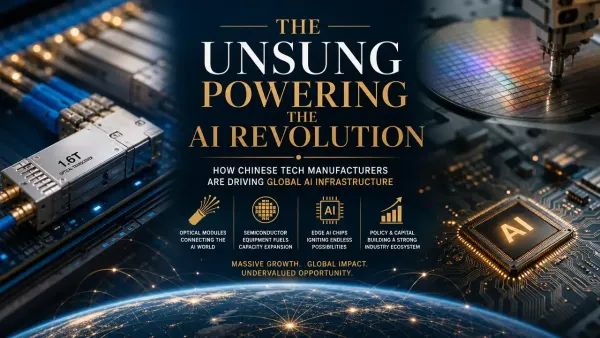
- Upstream (Infrastructure & Hardware): GPU supply chain companies, advanced optical transceiver manufacturers (光模块), high-bandwidth memory (HBM) packaging specialists, and data center operators are all seeing explosive demand. The MSCI China Materials Index surged 108% in 2025, partly fueled by AI infrastructure metals (copper for power grids, aluminum for cooling systems).
- Midstream (Platform & Software): China's leading internet conglomerates are aggressively deploying AI capabilities into their existing ecosystems — search, e-commerce, cloud, and financial services — at a speed that mirrors but undercuts the cost structure of U.S. Big Tech counterparts.
- Downstream (Applications & Agents): Vertical AI application companies in healthcare (gene therapy, AI diagnostics), industrial automation (robotics, smart manufacturing), and fintech are monetizing AI capabilities through real revenue-generating products, not just pilot projects.
Government Tailwind: The 15th Five-Year Plan
Under China's 15th Five-Year Plan (2026–2030), AI self-sufficiency is a declared national strategic priority. This translates to sustained, multi-year government procurement, R&D subsidies, and regulatory fast-tracking for domestic AI champions — a structural policy tailwind with no equivalent in the private-sector-led U.S. AI ecosystem.
Why This Matters for North American Portfolios
U.S. investors overweight in NVIDIA, Microsoft, and Google AI plays are concentrated in the most expensive part of the global AI trade. Chinese AI companies — available via A-share direct access, qualified ETFs, or MSCI China tracking funds — offer exposure to the same secular growth trend at a P/E discount of 40–50%. As Chinese AI models gain international commercial traction, the risk-reward of ignoring this market is increasing rapidly.
Specific A-Share Sectors to Watch:
- Advanced optical module manufacturers (光模块龙头)
- Domestic GPU/chip supply chain (国产算力产业链)
- AI healthcare application companies (AI医疗应用)
- Industrial robotics and smart manufacturing (工业机器人与智能制造)