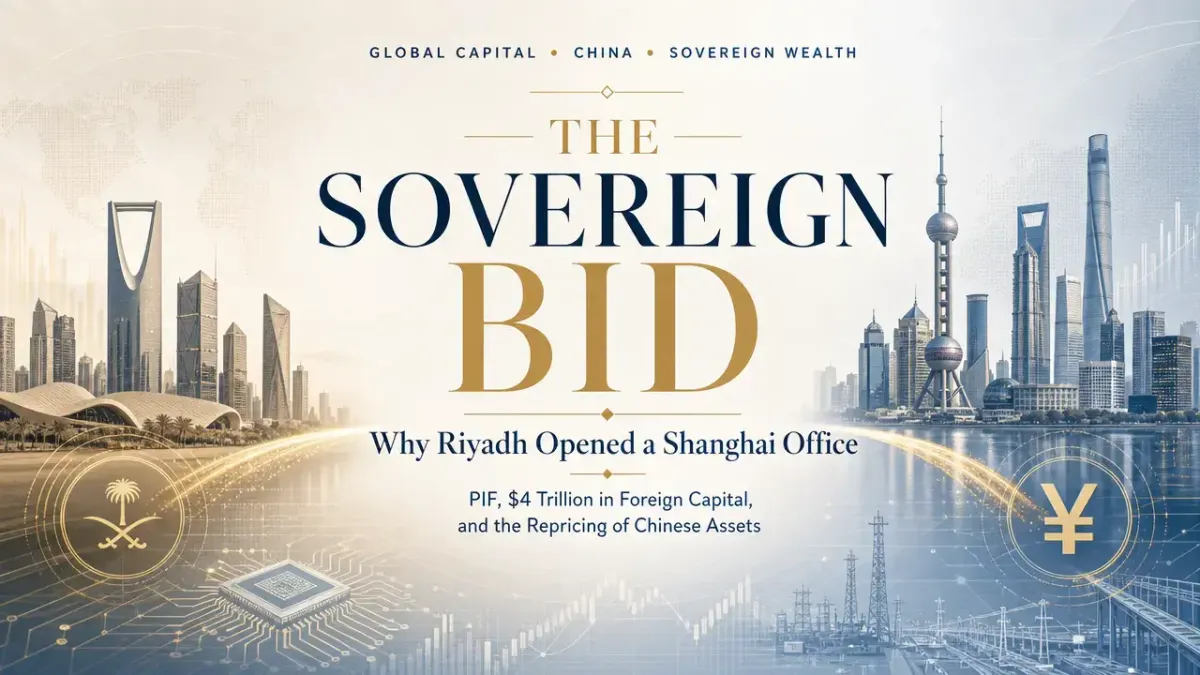
The Sovereign Bid: Why Riyadh Just Opened a Shanghai Office
PIF opened in Shanghai. Foreign A-share holdings hit RMB 4T. Gulf SWF participation in HK IPOs jumped from 18% to 39% in 18 months. What the world's largest patient capital pools are signaling about Chinese assets — and why most North American allocators are not yet listening.
The Sovereign Money Has a View. It Is Not the Consensus View.
On June 3, 2026, Bloomberg reported that Saudi Arabia's Public Investment Fund — the world's fifth-largest sovereign wealth fund, with assets exceeding $1 trillion — completed registration of its Shanghai office in 2025 and began formal operations this year. It is PIF's third mainland presence, joining Hong Kong (2022) and Beijing (2025). The fund now has more offices in China than in any other country outside the Kingdom.
That same day, China Central Television's flagship evening news program devoted a segment to long-term foreign capital "continuing to add to hard technology" in Chinese markets. Foreign investors now hold over RMB 4 trillion of A-share float — up nearly RMB 1 trillion from the same point a year earlier. In April 2026 alone, net foreign inflows reached approximately $29 billion, the largest single month of the year.
These are not isolated data points. They form a coherent picture. The largest pools of patient capital in the world — sovereign wealth funds, global multi-strategy allocators, long-duration insurance balance sheets — are increasing their exposure to Chinese equities at a moment when the prevailing North American narrative remains skeptical. The gap between what the sovereigns are doing and what the consensus is saying is itself the most important piece of information in the market right now.
Who Is Buying, and What That Tells Us
The composition of the foreign bid matters more than the headline number. PIF is not a hot-money flow. It is a multi-decade mandate operating under Saudi Arabia's Vision 2030 strategic framework, with explicit instructions to position the Kingdom for the post-oil global economy. Its allocations to China are not tactical. They are strategic statements about where the next twenty years of capital deployment make sense.
PIF's China footprint is now substantial: over 22billiondeployedacrossprimaryandsecondarymarkets,includinga22 billion deployed across primary and secondary markets, including a 22billiondeployedacrossprimaryandsecondarymarkets,includinga2 billion convertible debt investment in Lenovo through its subsidiary Alat, fund-of-fund commitments to Chinese venture managers including Yidatong Capital, and a $1 billion-plus joint private equity fund with Shenzhen Futian. The capital is concentrated in sustainable development, technology, automotive, and healthcare — sectors that align with Vision 2030's industrial transformation goals.
Other Middle Eastern sovereigns are following the same playbook. Per Wind data, Abu Dhabi Investment Authority (ADIA) and the Kuwait Investment Authority together appeared in 77 top-ten shareholder positions across A-shares as of Q1 2026, with combined holdings of RMB 21.8 billion. Their concentration is in hard technology — semiconductors, advanced manufacturing, materials, and electronics — with named positions including Zijin Mining, Luxshare Precision, Wanhua Chemical, BOE Technology, and Sany Heavy Industry.
The Hong Kong IPO market shows the same pattern. Middle Eastern sovereign participation in cornerstone investor positions has risen from 18% of Hong Kong IPOs in 2024 to 39.2% in early 2026. Qatar Investment Authority took a cornerstone slot in Eastroc Beverage's Hong Kong listing. ADIA cornerstoned MiniMax and Jingfeng Medical. Mubadala cornerstoned Richard Li's FWD Group.
This is not narrative-driven retail flow. This is sovereign-allocator due diligence translating into committed capital across both primary and secondary venues, and across both onshore and offshore venues.
Why Now: Three Structural Drivers
The acceleration of foreign sovereign capital into Chinese assets in 2025–2026 reflects three structural drivers that have nothing to do with short-term cyclical positioning.
First, valuation. The structural discount on Chinese equities relative to U.S. and Indian equivalents has reached the point where, on a forward earnings yield basis, A-share large-caps offer compensation for governance and policy risk that exceeds the realistic downside scenarios most allocators model. When sovereign wealth funds with twenty-year horizons begin allocating, it is typically a signal that the implied risk premium has become too generous to ignore.
Second, the AI verification cycle. Goldman Sachs has publicly described Chinese AI as "forming an independent investment thesis from global tech equities, with potential economic benefits that are severely underpriced." This is a substantive shift from prior framings of Chinese AI as a derivative of U.S. AI. The thesis rests on China's combination of large-scale consumer market depth, complete manufacturing supply chains, and increasingly competitive foundation models — a combination that provides commercial application infrastructure unavailable in any other market. KKR's Global Macro and Asset Allocation team, after a multi-week visit to China in April 2026, framed the shift as the rapid penetration of AI and automation across multiple industries having become directly observable.
Third, currency and policy alignment. The renminbi's strength in 2025–2026 is not, in KKR's published view, accidental. It reflects allocator demand for renminbi-denominated assets and signals that global capital is increasingly prepared to recognize Chinese competitiveness as resting on fundamentals rather than on currency suppression. This matters for sovereign allocators in particular because it removes one of the historic objections to large-scale RMB exposure — the concern that Chinese policy would manage the currency lower at the expense of foreign holders.
For sovereign funds operating with strategic mandates and decade-plus horizons, these three drivers compound rather than substitute. Cheap equities are interesting; cheap equities in a strengthening currency tied to a credible long-cycle technology thesis are something quite different.
What the Sovereigns Are Buying That the Consensus Is Not
The composition of sovereign capital flows is itself a useful contrarian indicator. ADIA, KIA, PIF, and Mubadala are not buying internet platforms or consumer brands at scale. They are buying:
- Hard technology infrastructure: BOE Technology (display panels and semiconductor process), Sany Heavy Industry (industrial automation), advanced manufacturing equipment names
- Materials and resources with strategic positioning: Zijin Mining (gold and copper), Wanhua Chemical (advanced chemicals), select rare earth and lithium positions
- Precision manufacturing and electronics: Luxshare Precision, with embedded positions across Apple's supply chain and emerging exposure to AI hardware
- Healthcare and biotechnology: through both direct A-share positions and Hong Kong IPO cornerstone investments in companies like Jingfeng Medical
This composition tells you what sovereigns believe will compound over twenty years. It is industrial, infrastructural, and capability-focused. It is not the China most North American retail investors think about when they think about Chinese equities. It is the China that supplies the world.
The Implication for Global Investors
The presence of $4 trillion in foreign capital in A-shares, with sovereign wealth funds expanding their physical presence and increasing committed positions, does not mean the China discount has closed. It means the closing has begun, and that the leading edge of capital movement is happening in venues — direct A-share large-cap positions, Hong Kong cornerstone investments, joint sovereign-domestic private equity funds — that most retail and even most institutional investors do not access.
The gap between sovereign positioning and consensus narrative is itself the opportunity. When sovereign wealth funds with forty-year horizons allocate, they are not betting on next-quarter earnings. They are betting that the structural mispricing of an entire market regime corrects over a multi-year window. Investors who wait for the consensus narrative to catch up will be allocating at materially higher multiples.
Three practical takeaways for non-Chinese investors.
First, watch what sovereigns hold, not what they say. Wind data and exchange-mandated disclosure of top-ten shareholders provide a quarterly window into ADIA, KIA, and similar positions. Tracking changes in those positions provides a higher-quality signal than commentary from the same institutions.
Second, the cornerstone investor list in Hong Kong IPOs is now a leading indicator. Sovereign cornerstone participation rising from 18% to 39% of deals in eighteen months is not noise. It is a structural shift in primary market dynamics that will increasingly affect secondary market pricing.
Third, the China underweight in most North American institutional portfolios is now a deliberate position, not a passive default. The decision to remain underweight China in 2026, with sovereigns buying and allocations rising, is an active call against the largest patient capital pools in the world. That call may be correct. It deserves to be made consciously rather than by inertia.
The Sovereign Bid Is Information
Markets do not always price information correctly in real time. The composition of who is buying matters as much as the volume. When the world's largest sovereign wealth funds simultaneously increase Chinese physical presence, expand committed capital, and concentrate purchases in hard technology and strategic infrastructure, that is information that should update priors regardless of what the prevailing narrative says.
The Saudi Public Investment Fund did not open a Shanghai office because of short-term momentum. It opened because the fund's mandate — preparing the Kingdom for the post-oil global economy — concluded that Chinese assets offer a return profile and strategic optionality that no other market currently matches. Other sovereigns reached the same conclusion through independent processes. The convergence is the signal.
What North American allocators do with that signal is the question that will define their China positioning for the next decade.